

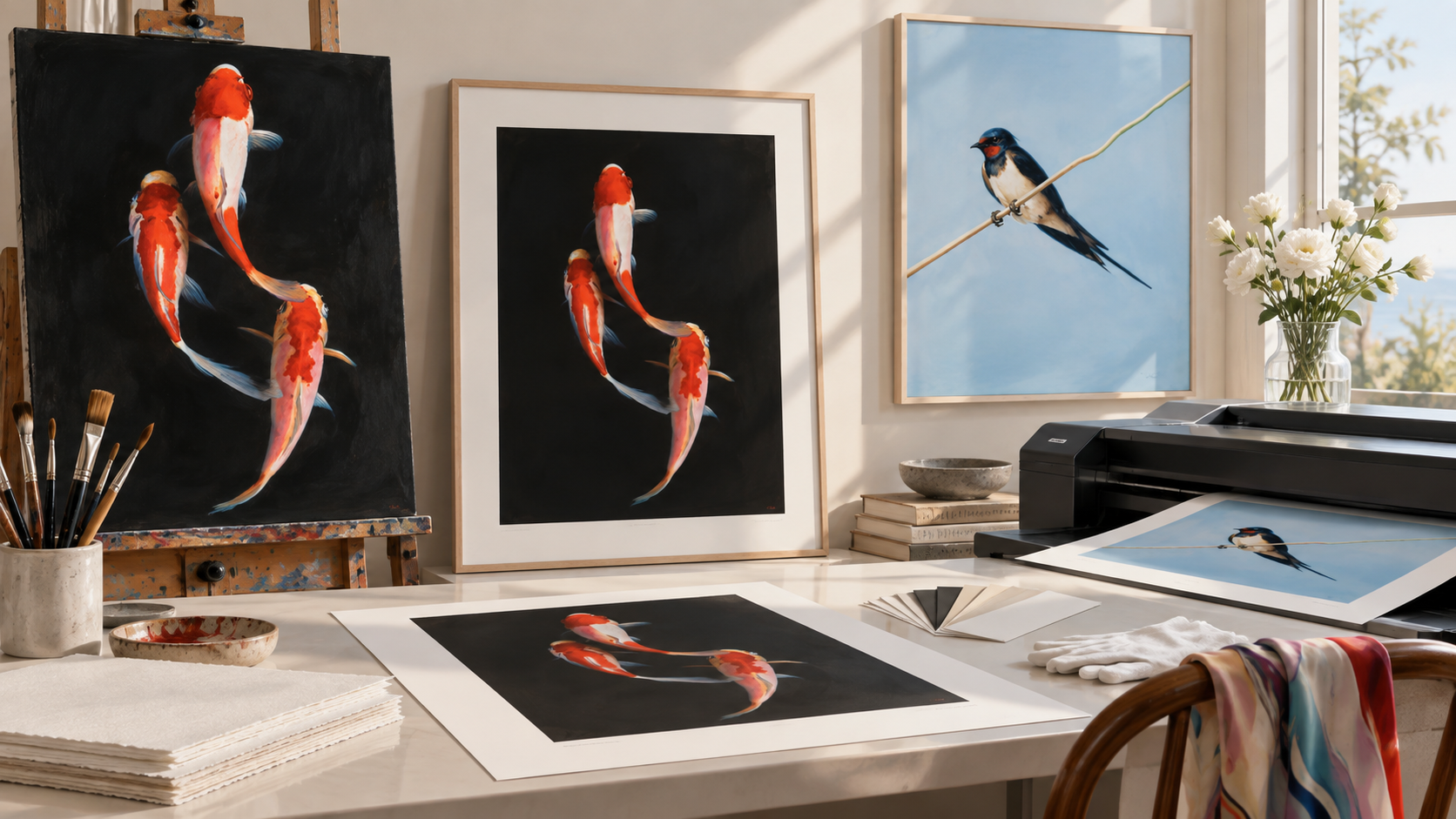
If you are looking for art prints, contemporary artworks, or a high-quality reproduction of a painting, you have probably come across the term giclée print. giclée print kifejezéssel.
But what exactly does giclée mean? How is it different from a traditional print or poster? Is it considered an original artwork? And what should you look for when buying a limited edition giclée print?
In short, a giclée print is an art reproduction created using a professional digital fine art printing process, designed to reproduce the colours, tonal range and details of the original artwork to a high standard. However, quality is not guaranteed by the term “giclée” alone: the printing technology, inks, substrate, colour management and overall quality of production all matter. However, quality is not guaranteed by the term “giclée” alone: the printing technology, the ink used, the substrate, color management, and the quality of the finish all play a role.
What Does the Word Giclée Mean?
The 'giclée' kifejezés a francia gicler The term giclée comes from the French word gicler, which refers to spraying or ejecting a fine stream of liquid. The name refers to professional inkjet printing technology, which builds up the image using extremely fine droplets of ink.
The term became widely used in fine art printing in the early 1990s to distinguish high-quality art reproductions from ordinary consumer inkjet prints.
It is important to note, however, that “giclée” is not, in itself, a legally or internationally standardised quality category. This is why, when buying a print, it is always worth checking what material it is printed on, what technology was used, and what type of edition it belongs to. What material was used, what technology was employed, and in what edition was the specific art print produced?.
How Is a Giclée Print Made?
Producing a truly high-quality art reproduction involves much more than simply printing a digital file of a painting.
1. Professional Digitisation of the Original Artwork
The first step is to digitize the original painting or artwork in high resolution. The goal is not simply to “photograph” the image, but to capture the original work as accurately as possible:
- colours,
- tonal transitions,
- contrast,
- fine details,
- textures.
from this perspective. This is particularly important in the case of a figurative or highly detailed painting.
2. Colour Correction and Preparation
The digital image must then be optimized for printing. The original artwork, the monitor, and the printed surface display colors differently; therefore, one of the most important parts of professional preparation is ensuring the proper color managementThe goal is for the finished print to visually resemble the original artwork as closely as possible.
3. Professional Fine Art Printing
In giclée printing, professional inkjet technology is used to apply extremely fine ink droplets to the chosen substrate. This high-quality process enables rich, detailed tones, smooth color transitions, and a wide color gamut.
4. Fine Art Paper or Artist Canvas
The quality of the image isn't determined solely by the printer. The medium itself is just as important. Giclée prints can be made, for example, on:
- fine art paper,
- cotton-based artist paper,
- specially manufactured archival paper,
- professional artist canvas.
The texture, whiteness, surface finish and weight of the substrate all influence the appearance of the finished artwork.
Giclée Print vs Traditional Poster: What Is the Difference?
At first glance, both could be reproductions of an original work of art. However, their purpose and execution can differ significantly. In the case of a mass-produced decorative poster, lower production costs and large print runs are typically the determining factors. In contrast, with a professionally produced fine art giclée print, the emphasis is on reproducing the visual character of the original work as accurately as possible, as well as on the quality of the substrate and the craftsmanship.
| Feature | Fine Art Giclée Print | Traditional Poster |
|---|---|---|
| Purpose | art reproduction | primarily decoration |
| Print quality | high | variable |
| Colour management | can be professional | generally less precise |
| Substrate | fine art paper or canvas | typically standard paper |
| Edition size | may be limited | generally large |
| Numbering | common with limited editions | generally none |
| Artist’s signature | possible | rare |
| Certificate of Authenticity | possible | generally none |
There is, however, an important distinction: giclée refers to the printing process, while limited edition, signature and Certificate of Authenticity are separate collector-related characteristics. There is, however, an important distinction: giclée refers to the printing process, while limited edition, signature and Certificate of Authenticity are separate collector-related characteristics. Not every giclée print is limited edition, and not every giclée print is signed.
Is a Giclée Print an Original Artwork?
This is one of the most frequently asked questions. A giclée print is generally not the original painting itself, but a high-quality reproduction of the original artwork. For example, if the original work is an oil-on-canvas painting, then the original work remains that specific, hand-painted piece. A limited-edition, numbered, and artist-signed giclée print, however, can be more than just a decorative reproduction. It can be part of an art edition with a specific number of copies, which has its own collector’s identity.
It is therefore important to distinguish between: original painting → a unique work created by the artist and limited edition giclée print → a fine art reproduction of the original artwork produced in a predetermined edition size.
What Does Limited Edition Mean?
The A limited edition means that only a predetermined number of copies of a particular artwork will be produced under the conditions of that edition., meaning that a limited edition refers to a situation in which only a predetermined number of copies of a given work are produced in accordance with the terms of that edition.
For example, if a print is marked: 3/15 If a work is marked as such, it generally means that the copy is the third in a 15-copy edition. A small print run does not in itself guarantee a work’s future value, but it provides collectors with important information about how many copies of that particular edition exist. When interpreting a limited edition, it is therefore worth examining:
- the total edition size,
- whether the print is numbered,
- whether it is signed by the artist,
- whether it comes with a Certificate of Authenticity,
- exactly which size and substrate the edition applies to.
What Does It Mean If a Giclée Print Is Signed and Numbered?
The signature establishes a direct connection between the edition and the artist. The numbering, in turn, indicates where a given print is located within the specific edition. A signed and numbered limited-edition giclée print Therefore, from a collector’s perspective, it may represent a different category than a reproduction produced in unlimited quantities. However, it is always a good idea to check the details of the specific work and edition before making a purchase.
What Is a Certificate of Authenticity?
The Certificate of Authenticity, in Hungarian, a certificate of authenticity is a document that records information regarding a specific work of art or art publication. Among other things, a certificate may include:
- the artist’s name,
- the title of the artwork,
- the medium,
- the dimensions,
- the edition size,
- the individual edition number,
- the artist’s signature.
For limited edition art prints, this can be particularly useful because it documents the relationship between the individual print and the edition to which it belongs.
Giclée Print or Original Painting – Which Should You Choose?
There is no single answer that applies to everyone. The two categories offer different artistic and collecting experiences.
Original Painting
An original painting is completely unique. The layers of paint, the brushwork, the surface texture, and the physical presence of the material are unique to the original work. It may be a good choice for those who:
- wants a one-of-a-kind artwork,
- values the physical presence of the original painting,
- is building a long-term art collection.
Limited Edition Giclée Print
A properly produced limited-edition giclée print offers the opportunity to own the visual world of the same artwork in a different form. It may be of particular interest to those who:
- admires the work of a particular artist,
- is not necessarily looking for an original painting,
- values high-quality reproduction,
- wants a limited and numbered edition,
- would like to display a larger artwork in their home.
So the two are not necessarily in competition with each other. They serve different purposes.
What Should You Look for When Buying a Giclée Print?
If you're choosing an art print, don't just look at the image itself. It's also worth asking yourself the following questions.
What Is It Printed On?
Fine art paper? Canvas? What type and weight?
Is It a Limited or Open Edition?
If it is limited, how many copies will be produced?
Is It Numbered?
Does the individual print have its own edition number?
Is It Signed by the Artist?
A signed and numbered print has a clearer connection to an edition approved by the artist.
Does It Come With a Certificate of Authenticity?
For a limited edition, this can be an important form of documentation.
How Large Is the Print?
Do not consider only the size of the wall. Think about the visual presence you want the artwork to have within the space.
Who Is the Artist?
This is perhaps the most important question. Ideally, we don’t choose a work of art because it matches the color of our sofa, but because there is something about it that speaks to us again and again.
Boglárka Nagy’s Limited Edition Giclée Prints
Selected paintings by Boglárka Nagy are also available as limited edition, signed and numbered fine art giclée prints. limited-edition, signed, and numbered fine art giclée prints are also available in this format. The current editions are professional on Canson MuseumArt ProCanvas Lustre 385 g/m² art canvas are produced on wooden frames. Each edition has a limited number of copies, and the prints come with a Certificate of Authenticity, as well as the artist’s signature and a serial number. The giclée selection includes works such as RETURN, THE BATHER, TRANQUILLITY, FREEDOM BLUES, COLORFUL STILETTOS and DESERT ANGEL. The print run and available sizes vary by title.
DISCOVER THE LIMITED EDITION GICLÉE PRINTS
An Art Print Can Be More Than Simple Wall Decoration
When choosing a piece of art, it’s easy to focus solely on size, color, or interior design. However, we live with a work of art for a long time. A well-chosen piece can take on new meanings over time, become linked to memories, and evolve into one of the most personal elements of a space. That’s precisely why, when selecting a giclée print, it’s not enough to ask only:
“Will it fit into my home?”
but also: “Would I like to live with this image for years to come?”
If the answer is yes, the artwork has already become much more than simple decoration.
Frequently Asked Questions About Giclée Prints
What Is a Giclée Print?
A giclée print is an art reproduction created using a professional digital fine art printing process. High-quality production aims to reproduce the colours, tonal range and details of the original artwork as accurately as possible.
Is a Giclée an Original Artwork?
Generally, it is not the original painting, but a reproduction of it. A limited, signed and numbered giclée print can, however, form part of a defined art edition.
What Is the Difference Between a Giclée Print and a Poster?
The main differences usually lie in the purpose of production, the quality of the printing and substrate, and the type of edition. Fine art giclée reproductions place greater emphasis on colour accuracy, detail and the quality of the artistic substrate.
Are All Giclée Prints Limited Editions?
No. Giclée prints can be produced as either open editions or limited editions. Before purchasing, it is always worth checking the edition details of the specific artwork.
What Does It Mean When a Print Is Numbered?
The numbering shows which individual copy the print is within a predetermined edition. For example, 4/15 usually means that the print is the fourth copy in an edition of fifteen.
Is a Signed Giclée Print More Valuable?
The artist’s signature, limited edition size, documented provenance and the artist’s recognition can all be relevant factors, but none of them alone guarantees future financial appreciation.
What Is a Fine Art Print?
A fine art print is an art reproduction in which the quality of reproduction, the substrate and the overall production process are given particular importance. Giclée is one of the widely used technologies for producing professional fine art reproductions.
How Should I Choose a Giclée Print?
First and foremost, choose an artwork with which you have a genuine visual or emotional connection. Then check the substrate, dimensions, edition size, signature, numbering and Certificate of Authenticity.
Discover Boglárka Nagy’s limited edition fine art giclée prints and learn more about the story, dimensions and available editions of each artwork.